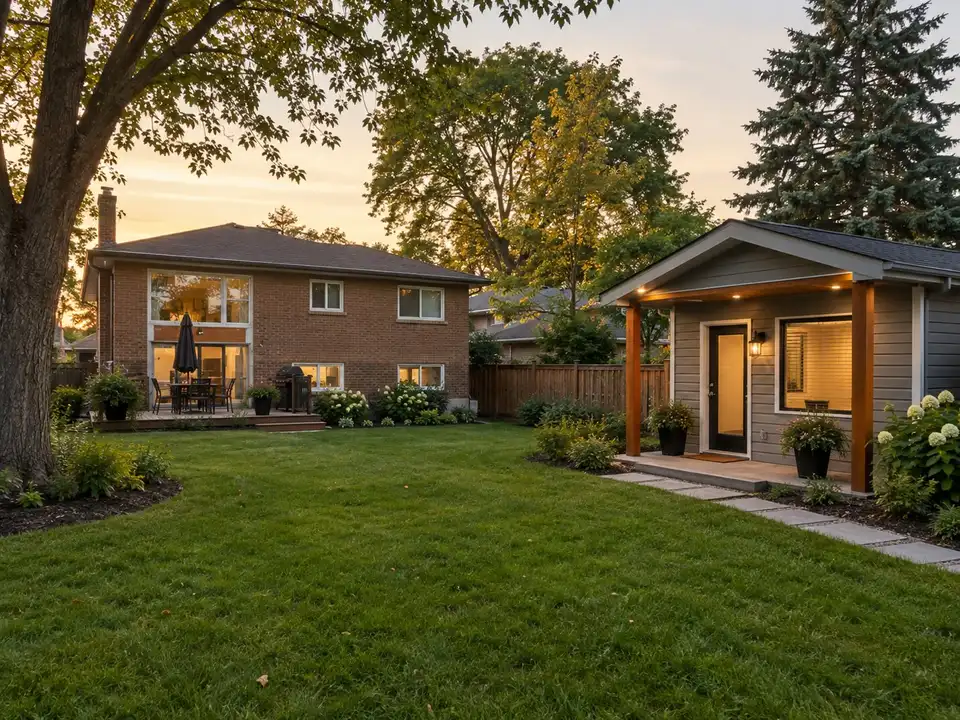
ReverseMortgageMississauga.ca covers what homeowners 55 and older need to know before building a garden suite in Mississauga or adding a basement apartment. The City now allows extra units on most house lots. A reverse mortgage can pay for the build, with no required monthly mortgage payments while you live in the main house.
The suite can be for a grown child, a caregiver or a tenant. Property taxes, home insurance and upkeep stay yours, for the house and the suite.
The first step for a suite: a free estimate
Everything starts with the free estimate form: about 90 seconds on your age, your home’s rough value and what is owing, with no effect on your credit.
Next, every reverse mortgage lender in Canada is checked against your home and the build you have in mind. The first email from Richard Hopkins, Mortgage Broker, shows how much you could get and which lenders fit, and asks how much the suite needs. The family member who may move in can be copied.
Once you’ve chosen an option, you send a few documents, such as the builder’s quote, the drawings and the City building permit when you have it. Nothing goes ahead unless you say so.
What Mississauga allows on your lot
Owners of a detached, semi-detached or townhouse lot can add up to two additional residential units, for three units in total (City of Mississauga, additional residential units). Only one of them can be a garden suite.
The choices include a basement apartment, a garage conversion, a second-floor conversion, an addition, or a garden suite of one or two storeys. A garden suite is also called a coach house, a laneway suite or a tiny home.
Council passed these rules in Zoning By-law 0174-2023 on November 10, 2023, so three units are allowed as of right (City of Mississauga, notice of passing). The City also allows a new fourplex on a lot instead.
Free plans and refunded fees
The City offers free pre-approved garden suite plans: a studio of about 40 square metres (430 square feet) and a one-bedroom of about 55 square metres (600 square feet). The layout can’t change, but the finishes can. A site plan and a grading plan are still required (City of Mississauga, June 4, 2024).
For a second or third unit, the building permit fee is refunded by cheque once the inspections are done. Those units are exempt from City and Region of Peel development charges and from parkland cash-in-lieu, a fee the City can charge new housing for parks, though a school board development charge may be payable (Gentle Density Table of Incentives, April 2026).
A garden suite needs its own municipal address, which costs $81.90 plus HST. Every second unit must also be registered with the City, and registration is free (City of Mississauga, registering a second unit).
Paying for the build from your home
A reverse mortgage lets you pay for the suite without a new monthly mortgage payment. You can take a lump sum when the build starts, or take part now and more later. Interest is charged only on the money you take.
The main house must stay your primary residence, the home you live in at least six months of the year. The suite doesn’t have to earn rent, because a reverse mortgage has no income test like a bank’s.
If the suite is for a caregiver, paying for home care from your home explains how monthly deposits can cover the care itself.
Home condition is part of every approval. The appraisal looks at your home as it is when you apply, and if a repair is already booked, it can sometimes be handled with a holdback, meaning the lender keeps that money aside until the job is finished. Building with a permit and passing the inspections also keeps the City’s fee refund in place.
An illustrative example: a detached home at the Mississauga median
Take an illustrative couple whose younger spouse is 65, in a detached home worth $1,219,000, the Mississauga median for September 2026 (TRREB Market Watch, September 2026). At 65, a reverse mortgage can reach up to about 50.55% of a home’s value, or about $616,200 on that $1,219,000 home.
They still owe $90,000 on their mortgage, and that $90,000 is paid off first at closing. That leaves up to about $526,200 available, which is not extra money on top of the mortgage.
They use the City’s free one-bedroom plan of about 55 square metres for a garden suite where their daughter will live. They take only what their builder’s written quote calls for, and interest is charged only on that. If they need more later, they can usually ask for it.
Drawing the money in stages as the suite is built
Taking the money in stages as the build moves along keeps interest lower, because interest is charged only on what you have drawn. The rate range was 6.23% to 6.94% (advertised 5-year fixed rates across the four lenders, checked September 17, 2026). Each draw joins the balance, and home price growth over the years often offsets some or all of the interest.
Your own lawyer’s independent legal advice, about $800 to $1,200 in Ontario, is part of the one-time costs, which commonly total about $2,000 to $3,500. Some lenders charge a fee or a different rate on later draws, and the Mississauga reverse mortgage calculator shows how a balance grows. The Mississauga reverse mortgage cost guide has the full list.
Nothing is repaid until the home is sold, or until the last borrower passes away or makes a permanent move, such as into one of the long-term care homes in Mississauga. The most you or your estate can ever owe is the fair market value of the home when the mortgage becomes due, provided the property taxes, insurance and upkeep have been kept up. This is typically called the no negative equity guarantee.
What you get when you ask for help
- A free estimate of what your home could provide for the build
- Every reverse mortgage lender in Canada compared for your home
- Every lender compared, and the best deal for your home and goals, by email
- The money timed around your builder's written quote
- A plain check on permits and home condition before you apply
- Only the amount the project needs, with the rest left untouched
- Family copied on every email, including the child moving in
- A free referral to an independent lawyer for your legal advice
Guides to read next
- What Does a Reverse Mortgage Cost on a Mississauga Home?
- Mississauga Long-Term Care Homes: Costs and What Happens to Your Home
Sources
Numbers last checked October 15, 2026.
- City of Mississauga, Additional residential units (checked October 15, 2026)
- City of Mississauga, Mississauga makes adding a garden suite easy with free design plans (June 4, 2024)
- City of Mississauga, Notice of passing of OPA 163 and Zoning By-law 0174-2023 (November 16, 2023)
- City of Mississauga, Gentle Density Table of Incentives (April 2026)
- City of Mississauga, Registering a second unit (checked October 15, 2026)
- TRREB, Market Watch, September 2026 (Mississauga sales by home type, published October 6, 2026)