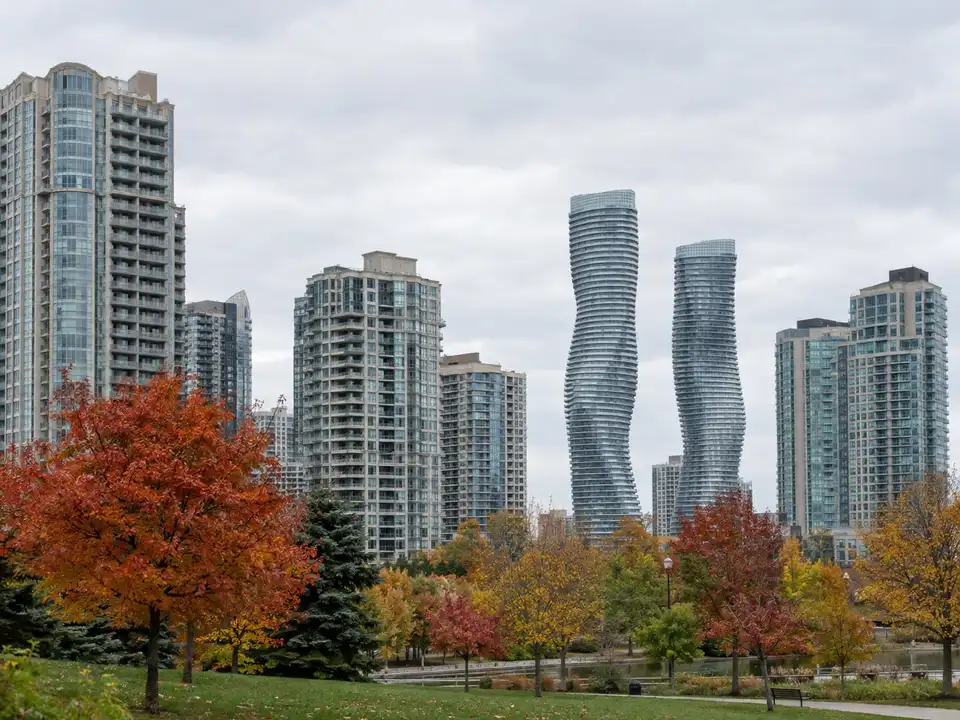
ReverseMortgageMississauga.ca explains how a reverse mortgage on a Mississauga condo works, from the first estimate to the money in your bank account. A condo apartment or a condo townhouse can qualify, and you keep living there with no required monthly mortgage payments. The pages are written for owners 55 and older and for the adult children helping them.
Property taxes, home insurance, upkeep and your condo fees stay yours to pay. The reverse mortgage replaces any mortgage payment, and it can give you money for everything else.
How it starts for a condo owner
The free estimate form is the first step. In about 90 seconds it asks your age, the condo’s rough value and what you still owe, and it doesn’t affect your credit.
Your unit and building are then checked against every reverse mortgage lender in Canada. The first email from Richard Hopkins, Mortgage Broker, shows how much you could get and which lenders fit, and asks how much you want. A son or daughter can be copied on every message.
Once you’ve chosen an option, you send a few documents, such as your latest condo fee statement and the status certificate (the condo corporation’s document on its finances, fees and rules). You sign nothing before that, and you can stop at any point.
What Mississauga condos are selling for
Condos made up a large part of what sold in Mississauga in September 2026. Of 468 sales, 122 were condo apartments and 61 were condo townhouses, so about 39% of all sales were condos (TRREB Market Watch, September 2026).
The median condo apartment sold for $432,500 that month, and the median condo townhouse for $686,000. The MLS benchmark price (TRREB’s price for a typical home of that type) for a Mississauga apartment was $488,300, down 7.62% from a year earlier (TRREB Market Watch, September 2026).
Your building and neighbourhood change the number
Condo prices differ a lot across the city. In Port Credit, the median condo apartment sold for $785,000 from April to June 2026 (17 sales). In Meadowvale, the median was $435,000 (9 sales) (TRREB Community Market Report, Mississauga, 2026 Q2).
City Centre was farmland until Square One opened in 1973, and it is now the city’s main cluster of high-rise towers (Wikipedia, Mississauga City Centre). Homes there averaged $498,700 across 148 sales from April to June 2026 (TRREB Community Market Report, Mississauga, 2026 Q2).
For your own figure, the Mississauga reverse mortgage calculator starts from these TRREB numbers. The September 2026 Mississauga home prices post has the full breakdown by home type.
What lenders look at in a condo
Before a condo is approved, the lender checks three things: what the unit is worth, the health of the building and its condo corporation, and where it is. The building review is the one owners don’t expect.
Lenders want a condo corporation whose rules allow the mortgage. They also look for healthy finances, fair fees and a well-kept building, and each of the four draws that line in its own place. So one lender may say yes to a unit that another turns down, which is why every lender gets compared for your building.
Two kinds of condo never qualify. A leasehold condo sits on land you don’t own, and a co-op gives you shares instead of the unit. A standard condo, registered in your name, qualifies with every Canadian reverse mortgage lender.
The percentage a lender offers on a condo can run a little differently than on a detached house. The appraisal, done by a professional appraiser who visits the unit, sets the final figure.
An illustrative example: a condo apartment at the Mississauga median
Take an illustrative single owner, aged 75, with a condo apartment worth $432,500, the Mississauga median for September 2026. At 75, a reverse mortgage can reach up to about 57.75% of a home’s value, or about $249,800 on that $432,500 unit.
The owner still has $30,000 on a line of credit. That $30,000 is paid off first at closing, out of the same money, which leaves up to about $219,800 available. The ceiling is not extra money on top of what is owed.
The owner takes $40,000 at closing as a cushion for condo fees and repairs. Interest is charged only on that $40,000, and the owner can usually ask for more later. The condo fees, property taxes and insurance stay the owner’s to pay.
Condo fees, interest and repayment
Condo fees stay your bill after closing, along with property taxes and insurance. Rates ran 6.23% to 6.94% (advertised 5-year fixed rates across the four lenders, checked September 17, 2026). Interest is added to the balance rather than paid each month, and rising home prices over the years often offset some or all of it.
One-time costs commonly total about $2,000 to $3,500, and that includes independent legal advice from your own lawyer, about $800 to $1,200 in Ontario. The Mississauga reverse mortgage cost guide lists each one. Selling the condo in the first few years brings an early repayment charge, so a likely move is part of every recommendation.
The balance becomes due once the condo is sold, or once the last borrower has moved out for good or passed away. The most you or your estate can ever owe is the fair market value of the home when the mortgage becomes due, provided the property taxes, insurance and upkeep have been kept up. This is typically called the no negative equity guarantee.
What you get when you ask for help
- A free estimate for your condo that doesn't affect your credit
- Every reverse mortgage lender in Canada compared for your building
- Every lender compared, and the best deal for your home and goals, by email
- A plain check on whether your unit is leasehold or a co-op
- The condo documents a lender asks for, explained in plain words
- A plan for condo fees and property taxes after closing
- Family copied on every email, if you want them there
- A free referral to an independent lawyer for your legal advice
How the choices stack up
| What is compared | Sell the condo | Home equity line of credit | Reverse mortgage |
|---|---|---|---|
| Do you stay in your condo? | No, you move | Yes | Yes |
| Monthly payments | None, but you pay rent or buy again | Required, and they rise with the prime rate | No required monthly mortgage payments |
| Income test | None | Yes, a bank stress test | No stress test; income checked only for the property taxes |
| Interest | None | Paid every month | Added to the balance, compounded twice a year |
| One-time costs | Commission, land transfer tax on the next home, legal and moving costs | Legal and appraisal costs | About $2,000 to $3,500, including your own lawyer |
Guides to read next
- What Does a Reverse Mortgage Cost on a Mississauga Home?
- Is There a Land Transfer Tax in Mississauga? What Downsizing Costs
- Does Mississauga Have a Property Tax Rebate for Seniors?
Sources
Numbers last checked October 15, 2026.